Government Figures Show England Rough Sleeping Figures Rose 20% in Last Year
February 27, 2025
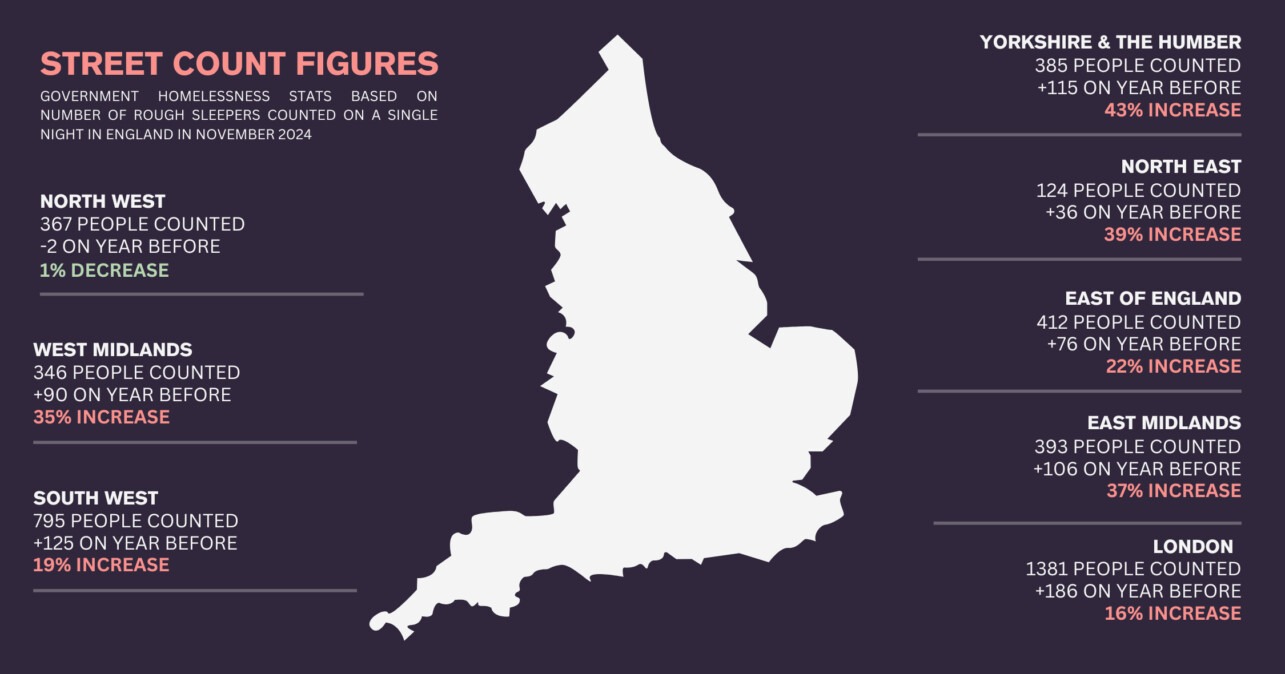
Official figures released today by the Ministry of Housing, Communities and Local Government (MCHLG) show the number of rough sleepers counted on a single night in England in November 2024 rose to 4,667 compared to 3,898 for the same period last year. This figure represents a rise of 20% or 769 people and is an increase of 2,899 people since the street count began in 2010.
The Government’s ‘Everyone In’ campaign during the pandemic led to a sharp fall in street homelessness but since 2022, numbers have been rising again. This is largely down to the cost-of-living crisis, lack of affordable homes, and the former Government’s efforts to reduce the asylum backlog which saw newly granted refugees being evicted from Home Office accommodation with nowhere to go and very little notice.
The annual street count is a physical count of rough sleepers in all local authorities in England and is the government’s benchmark measure for progress towards its manifesto commitment to end rough sleeping within five years.
For a rough sleeper to be included in the count, there are strict criteria, with the Government definition counting ‘people sleeping, or bedded down, in the open air (such as on the streets, or in doorways, parks or bus shelters); not people in buildings or other places not designed for habitation (such as barns, sheds, car parks, cars, derelict boats, stations, or ‘bashes’)’.
Housing Justice’s Chief Executive Bonnie Williams said: “As the sixth richest economy in the world, it is disappointing that this year’s street count figures have risen again. We are looking to the Government’s new rough sleeping strategy to address this immediate crisis as well as moving towards a focus on homelessness prevention. It is also vital to ensure that people do not return to the streets once they have found a home, and that they are supported to find belonging and connection within their community.
“The non-commissioned night shelters in Housing Justice’s network provided accommodation for 4,200 individuals this winter, meaning the street count would have been 50% higher without those beds. Community-based homelessness prevention schemes and accommodation options such as these are vital to alleviating homelessness, and we would like to see this recognised in the Government’s strategy and the upcoming Comprehensive Spending Review.”